
How neutral atoms in optical tweezers build a quantum computer
Arrays of tightly focused laser beams trap individual atoms, while laser-driven Rydberg states provide the strong interactions needed to entangle and shuttle qubits without physical wires.

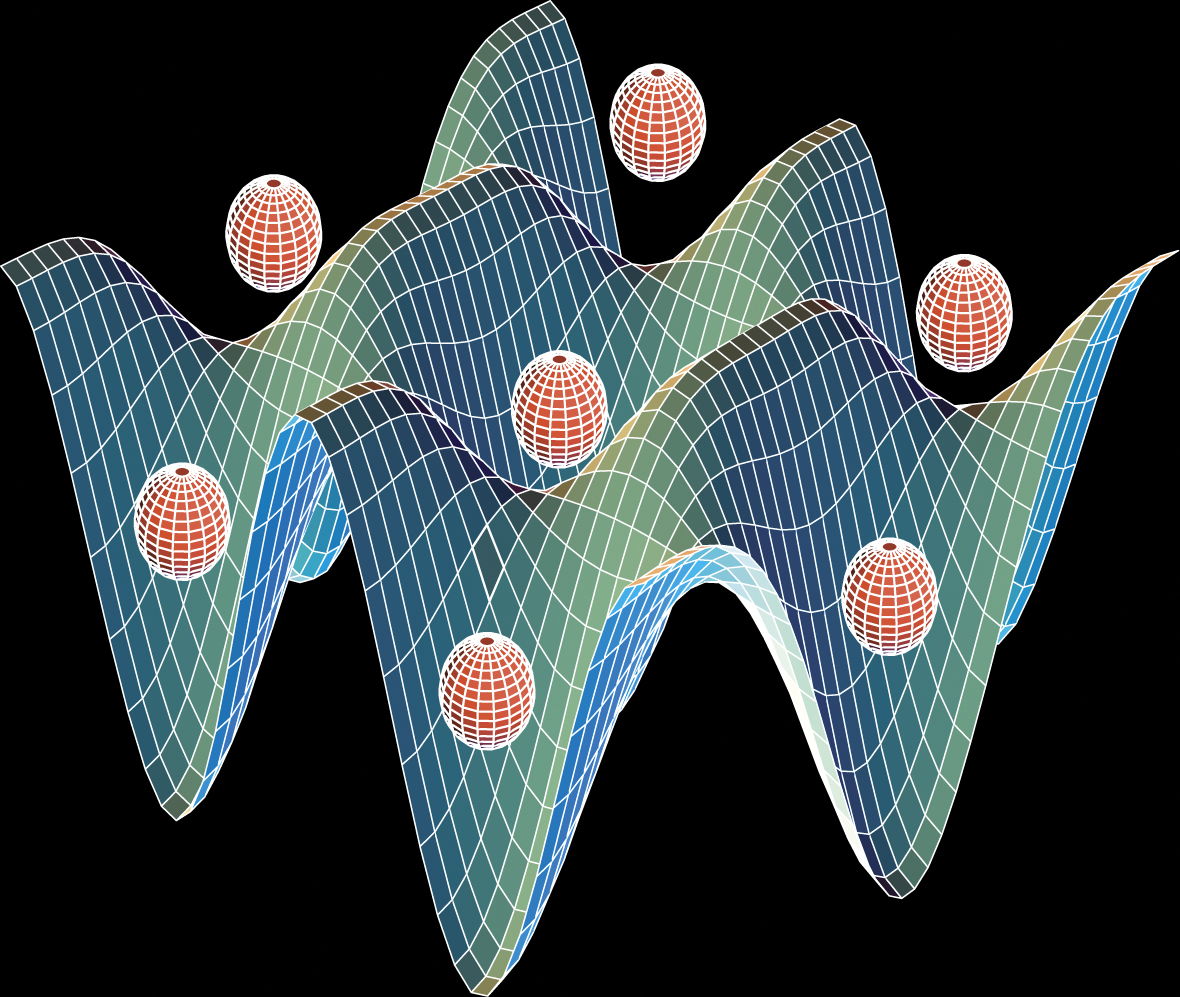
The neutral-atom approach to quantum hardware
Building quantum computing hardware requires balancing two opposing physical demands. A qubit must decouple from stray environmental noise during idle storage, yet it must interact strongly with selected partners to execute multi-qubit logic gates.
Different physical platforms resolve this trade-off in distinct ways. Superconducting processors rely on lithographic planar circuits coupled through microwave resonators. This design permits fast gate operations, but micro-fabrication inhomogeneities produce site-to-site variations, and fixed on-chip wiring constrains connectivity. Trapped ions provide identical atomic transitions and long coherence times, but their shared positive charge causes long-range Coulomb repulsion, which complicates dense two-dimensional scaling.
Neutral atoms in their electronic ground states offer an alternative starting point. Carrying zero net electric charge, they do not experience Coulomb repulsion. At separations of several micrometers, their permanent electric dipole moments vanish, yielding negligible mutual interactions. Every atom of a chosen isotope is identical by fundamental symmetry, removing the device variations found in lithographic circuits.
The platform addresses the conflict between isolation and interaction by operating in two physical regimes. During storage and transport, atoms remain in electronic ground states, where they interact weakly and decouple from stray background fields. When entangling gates are required, resonant laser pulses promote valence electrons to high-lying Rydberg states. These extended orbitals introduce strong dipole-dipole interactions, which persist for the laser pulse duration and vanish once atoms return to the ground state.
Optical tweezers and the dipole force
Neutral atoms are confined without physical walls using optical tweezers: far-off-resonance optical dipole traps formed by focusing laser beams to sub-micrometer waists through high numerical aperture objectives.
The trapping mechanism relies on the AC Stark effect. An oscillating optical electric field induces an electric dipole moment in the atom, where is the dynamic polarizability at laser frequency . The time-averaged interaction energy yields the conservative optical dipole potential:
where is the cycle-averaged laser intensity. In a two-level atom model with transition frequency and spontaneous decay rate , the real dynamic polarizability is:
Tuning the laser below atomic resonance () produces red detuning () and a positive polarizability, . The resulting negative potential draws polarizable atoms toward the intensity maximum.
For a Gaussian beam propagating along the -axis with power , waist , and Rayleigh range , the intensity profile is:
with . Expanding near the focal maximum gives harmonic trap oscillation frequencies:
where is the trap depth and is the atomic mass. In rubidium experiments (, , ), trap depths reach (). Atoms pre-cooled via optical molasses to reside deep within the conservative potential.
In addition to the conservative potential, atoms scatter photons from the trapping laser through Rayleigh scattering. The off-resonance scattering rate is:
Because the dipole potential scales inversely with detuning as while the photon scattering rate scales as , optical tweezers operate in the far-detuned regime. Large red detunings (often tens of nanometers away from the rubidium D1 and D2 resonance lines) ensure that optical trap depths remain sufficient for deep spatial confinement while holding spontaneous scattering rates below several photons per second. This low scattering rate prevents photon recoil heating from ejecting atoms during computational cycles.
Loading single atoms and assembling defect-free arrays
Focusing an optical tweezer waist below one micrometer induces light-assisted collisional blockade when loading from a laser-cooled background vapor. This collisional loss restricts tweezer occupation to either zero or one atom.
Under near-resonant cooling light, two atoms in the same microtrap absorb a photon and collide along an attractive molecular potential:
When the quasimolecule decays back to the repulsive ground curve, the acquired kinetic energy splits between both atoms. Because this energy gain exceeds the millikelvin trap depth , both atoms escape the tweezer. Consequently, whenever a second atom enters an occupied site, both are lost. This pairwise mechanism bounds single-atom loading efficiency to approximately .
Assembling deterministic, defect-free arrays requires active rearrangement:
- Static arrays of hundreds of microtraps are formed using a spatial light modulator that imprints computed phase holograms on a trapping laser, generating two-dimensional grids of diffraction-limited focal spots.
- The initial stochastic occupancy is mapped within tens of milliseconds using fluorescence imaging. Cooling beams scatter photons from trapped atoms, which are collected by an electron-multiplying charge-coupled device or scientific CMOS camera.
- A control processor calculates collision-free relocation paths. Mobile tweezers driven by two-dimensional acousto-optic deflectors extract atoms from filled sites and transport them to vacant target sites.
This rearrangement produces defect-free target arrays containing hundreds of resolved atoms with filling fractions exceeding in under fifty milliseconds.
Encoding qubits in ground-state hyperfine levels
Long-lived computational states are encoded in the ground electronic manifold of alkali atoms such as rubidium-87 (, nuclear spin ).
The computational basis states are mapped to two hyperfine sublevels:
These states are separated by the ground-state hyperfine splitting:
This transition provides an atomic clock reference. Because both states have magnetic quantum numbers , their differential Zeeman shift vanishes to first order in the magnetic field:
Residual magnetic sensitivity arises at second order through the Breit-Rabi formula:
where for . Surrounding the chamber with mu-metal shielding and applying stable Helmholtz bias fields suppresses magnetic dephasing.
Qubit register initialization begins with optical pumping. By illuminating the laser-cooled atoms with circularly polarized light tuned to the transition alongside a repumping beam, atoms undergo spontaneous optical cycling until they settle into the dark state , achieving state preparation fidelities above .
Two-photon Raman transitions provide coherent local control over single-qubit rotations. Two laser beams with frequency difference drive transitions via a virtual intermediate level detuned by several gigahertz from the or manifolds. Aligning the two Raman beams in a co-propagating geometry sets the effective wavevector to , which suppresses Doppler sensitivity and motional dephasing during single-qubit rotations. The bare dephasing time for these clock qubits spans one to four seconds, and dynamical decoupling sequences such as Carr-Purcell-Meiboom-Gill or XY-8 pulse trains extend coherence times past ten seconds.
The Rydberg state and van der Waals interactions
Ground-state neutral atoms separated by several micrometers exhibit negligible mutual interaction. To generate entanglement for multi-qubit logic, atoms are excited to high-lying Rydberg states using coherent laser pulses.
A Rydberg state is an electronic configuration where a valence electron is promoted to a high principal quantum number , typically between and (such as ). Single-photon ultraviolet light near , or two-photon transitions near and , drives these excitations.
Rydberg states exhibit extreme physical properties that scale steeply with :
- The mean electron orbital radius scales as , with Bohr radius . For , the orbital radius exceeds .
- The electric dipole matrix element to adjacent states scales as .
- The atomic polarizability scales as , making Rydberg levels responsive to weak electric fields.
- The radiative lifetime scales as . At room temperature, blackbody-induced transitions reduce this lifetime to , which remains much longer than microsecond gate operations.
Separated by distance without static electric fields, two Rydberg atoms interact through the dipole-dipole Hamiltonian:
where is the dipole operator and is the interatomic unit vector. For two atoms in the pair state , the dipole-dipole Hamiltonian couples them to intermediate pair states with an energy defect . When this energy defect is non-zero, second-order perturbation theory produces an isotropic van der Waals potential:
The dispersion coefficient scales with transition dipole moments squared divided by the energy spacing to adjacent manifolds:
This scaling amplifies interactions by twelve orders of magnitude over ground states. For in , . At , the interaction energy exceeds , producing strong coupling on microsecond timescales. Small external electric fields can tune the energy defect toward zero through DC Stark shifts. At these electric-field-induced Förster resonances, the interaction switches from the van der Waals regime to the longer-range resonant dipole-dipole regime.
The Rydberg blockade and two-qubit entangling gates
The van der Waals interaction between Rydberg atoms gives rise to the Rydberg blockade, which provides the mechanism for two-qubit entangling gates.
An ensemble of neutral atoms driven by a laser field coupling qubit state to Rydberg state with Rabi frequency and detuning is described by the many-body Hamiltonian:
where and .
The Rydberg blockade radius marks the distance where the interaction energy matches the laser excitation linewidth:
For and , the blockade radius is approximately .
When two atoms are held at , excitation of one atom shifts the doubly excited state by . This energy shift takes the laser out of resonance for the second excitation, preventing simultaneous promotion to . Dynamics are confined to the single-excitation subspace, oscillating between and with collective Rabi frequency .
The Levine-Pichler controlled-phase () gate employs this blockade under a modulated laser pulse:
- State does not couple to the light and accumulates no phase.
- States and have one atom in , which executes a rotation through , acquiring geometric phase .
- State couples to the field, but blockade forbids transition into . The single excitation traverses a restricted path, returning to with phase .
Selecting detuning and pulse duration to satisfy implements the diagonal unitary:
The fidelity of the resulting entangling gate is quantified through quantum state tomography and parity oscillations. Starting from the separable input state , applying the controlled-phase gate followed by a global analysis pulse creates the maximally entangled Bell state:
Scanning the optical phase of the analysis pulse produces oscillations in the parity operator . The amplitude of these parity oscillations, combined with populations measured in the computational basis, determines the entangled state fidelity. In 2023, Evered and colleagues reported two-qubit gate fidelities of in neutral-atom arrays, reaching fault-tolerance thresholds.
Dynamic shuttling and non-local circuit connectivity
In fixed planar architectures such as superconducting circuits, qubits interact only with nearest neighbors on a chip. Executing gates between distant nodes requires chains of intermediate SWAP operations that accumulate depth and error.
Neutral-atom processors avoid this bottleneck through dynamic atom transport. Because tweezers are generated optically, atoms can be translated across the register during circuit execution:
- Target atoms sit in static traps produced by a spatial light modulator. Mobile tweezers generated by a two-dimensional acousto-optic deflector overlap with target sites.
- Mobile trap power is ramped up as static traps extinguish, transferring atoms into mobile potentials without heating.
- Frequency-swept radiofrequency drives translate the optical focal spots across tens to hundreds of micrometers, positioning atoms adjacent to target partners.
- Laser pulses apply entangling gates within the blockade radius , after which atoms can be relocated or returned to storage.
To prevent motional heating, transport trajectories must maintain adiabaticity in the trap. Trajectories follow quintic polynomials:
with transport distance and duration . This parameterization ensures velocity and acceleration vanish at the endpoints.
At velocities of , a translation completes in roughly , with vibrational heating measured below quanta per round trip. Differential AC Stark shifts induced by moving traps are calibrated and canceled in real time through phase updates on single-qubit drive lasers. This transport enables arbitrary connectivity across large arrays without physical wires or SWAP overhead.
Logical qubits and the path to fault tolerance
Scaling quantum computation to deep circuits requires quantum error correction, where quantum information is encoded across collective entangled states of multiple physical qubits.
Neutral-atom arrays are well suited to topological and surface error-correcting codes. Dynamic shuttling allows physical qubits to be partitioned across dedicated functional zones:
- Storage zones hold idle data qubits in dark optical potentials away from scattered light.
- Entangling zones receive selected atoms for parallel multi-qubit Rydberg gates.
- Readout zones isolate ancilla qubits for mid-circuit state detection.
This spatial separation prevents resonant imaging photons during ancilla measurement from decohering neighboring data qubits. Ancillae are shuttled to the readout zone, illuminated to detect error syndromes, and recooled without disturbing data registers.
Transport also permits the execution of transversal gates, which act bitwise between corresponding physical qubits of separate code blocks. Because transversal gates do not spread errors within a code block, they are fault-tolerant by design. In neutral-atom systems, entire two-dimensional arrays of physical qubits belonging to one logical block can be shuttled into position and entangled with a second block using a single global Rydberg pulse.
In 2024, Bluvstein and collaborators operated a logical quantum processor based on reconfigurable arrays of rubidium atoms. The processor supported up to 48 logical qubits using distance-two detection codes ( codes) and color codes ( Steane codes). The demonstration showed fault-tolerant state preparation, logical feedforward, and the creation of logical Greenberger-Horne-Zeilinger states. Logical error rates systematically dropped below physical error rates during error detection, showing the viability of the architecture for fault-tolerant quantum computing.
Systematic decoherence and physical limits
While neutral-atom processors have achieved high gate fidelities and reconfigurable connectivity, several physical mechanisms constrain coherence:
- Finite Rydberg lifetime: Spontaneous emission and blackbody radiation limit Rydberg state lifetimes. For rubidium at , the lifetime at is . During a gate pulse, decay induces an intrinsic error floor near , capping two-qubit gate fidelities near . Cryogenic environments at reduce blackbody radiation, extending lifetimes past one millisecond.
- Laser phase noise: Coherent Rydberg driving requires optical fields in the ultraviolet or blue spectrum. High-frequency laser phase noise transfers to qubit state dephasing during excitation. Mitigating this error requires locking gate lasers to ultra-low-expansion reference cavities with sub-kilohertz linewidths.
- Thermal motion and Doppler dephasing: At , atoms retain thermal velocities . Motion along the Rydberg beam propagation axis produces Doppler shifts , introducing trajectory-dependent phase errors. Raman sideband cooling to the three-dimensional motional ground state suppresses this dephasing.
- Background gas collisions: In ultra-high vacuum (), collisions with residual gas molecules eject atoms on timescales of ten to one hundred seconds. Cryogenic pumping further reduces residual gas pressures, extending trapping lifetimes to hours.
To address these limits, architectures are expanding to include alkaline-earth atoms such as ytterbium-171 () and strontium-88 (), as well as dual-element mixtures ( and ). Alkaline-earth atoms have two valence electrons, providing optical clock transitions and nuclear-spin qubits with . This structure allows erasure error conversion: Rydberg decay predominantly populates metastable states that can be detected via optical cycling without destroying the computational state. Converting physical decay into localized erasure errors raises fault-tolerance thresholds, supporting the development of scalable quantum processors.
References
- D. Jaksch, J. I. Cirac, P. Zoller, S. L. Rolston, R. Côté, and M. D. Lukin, "Fast Quantum Gates for Neutral Atoms," Physical Review Letters 85, 2208 (2000). DOI: 10.1103/PhysRevLett.85.2208
- M. D. Lukin, M. Fleischhauer, R. Côté, L. M. Duan, D. Jaksch, J. I. Cirac, and P. Zoller, "Dipole Blockade and Quantum Information Processing in Mesoscopic Atomic Ensembles," Physical Review Letters 87, 037901 (2001). DOI: 10.1103/PhysRevLett.87.037901
- H. Levine, A. Keesling, G. Semeghini, A. Omran, H. Bernien, S. Schwartz, V. Vuletić, and M. D. Lukin, "Parallel Implementation of High-Fidelity Multiqubit Gates with Neutral Atoms," Physical Review Letters 123, 170503 (2019). DOI: 10.1103/PhysRevLett.123.170503
- D. Bluvstein, A. Omran, H. Levine, A. Keesling, G. Semeghini, S. Ebadi, T. T. Wang, A. A. Michailidis, N. Maskara, W. W. Ho, S. Choi, M. Serbyn, M. Greiner, V. Vuletić, and M. D. Lukin, "A quantum processor based on coherent transport of entangled atom arrays," Nature 604, 451-456 (2022). DOI: 10.1038/s41586-022-04592-6
- S. J. Evered, D. Bluvstein, M. Kalinowski, S. Ebadi, T. Manovitz, H. Zhou, S. H. Li, A. A. Geim, T. T. Wang, N. Maskara, H. Levine, G. Semeghini, M. Greiner, V. Vuletić, and M. D. Lukin, "High-fidelity parallel entangling gates on a neutral-atom quantum computer," Nature 622, 268-272 (2023). DOI: 10.1038/s41586-023-06481-y
- D. Bluvstein, S. J. Evered, A. A. Geim, S. H. Li, H. Zhou, T. Manovitz, S. Ebadi, M. Cain, M. Kalinowski, D. Hangleiter, J. P. Bonilla Ataides, N. Maskara, I. Cong, X. Gao, P. Sales Rodriguez, T. Karolyshyn, G. Semeghini, M. J. Gullans, M. Greiner, V. Vuletić, and M. D. Lukin, "A logical quantum processor based on reconfigurable atom arrays," Nature 626, 58-65 (2024). DOI: 10.1038/s41586-023-06927-3
- S. Ma, G. X. Meng, Y. Zhou, P. Scholl, E. F. K. W. Wong, N. Bhatt, J. Choi, and J. D. Thompson, "High-fidelity gates and mid-circuit erasure conversion in an atomic qubit," Nature 622, 279-284 (2023). DOI: 10.1038/s41586-023-06516-4
- Cover illustration credit: National Institute of Standards and Technology (NIST), Optical Lattice Image Gallery (2017).