
How laser light slows an atom
A photon can push an atom, and a carefully tuned set of lasers can turn those tiny pushes into cooling and confinement.

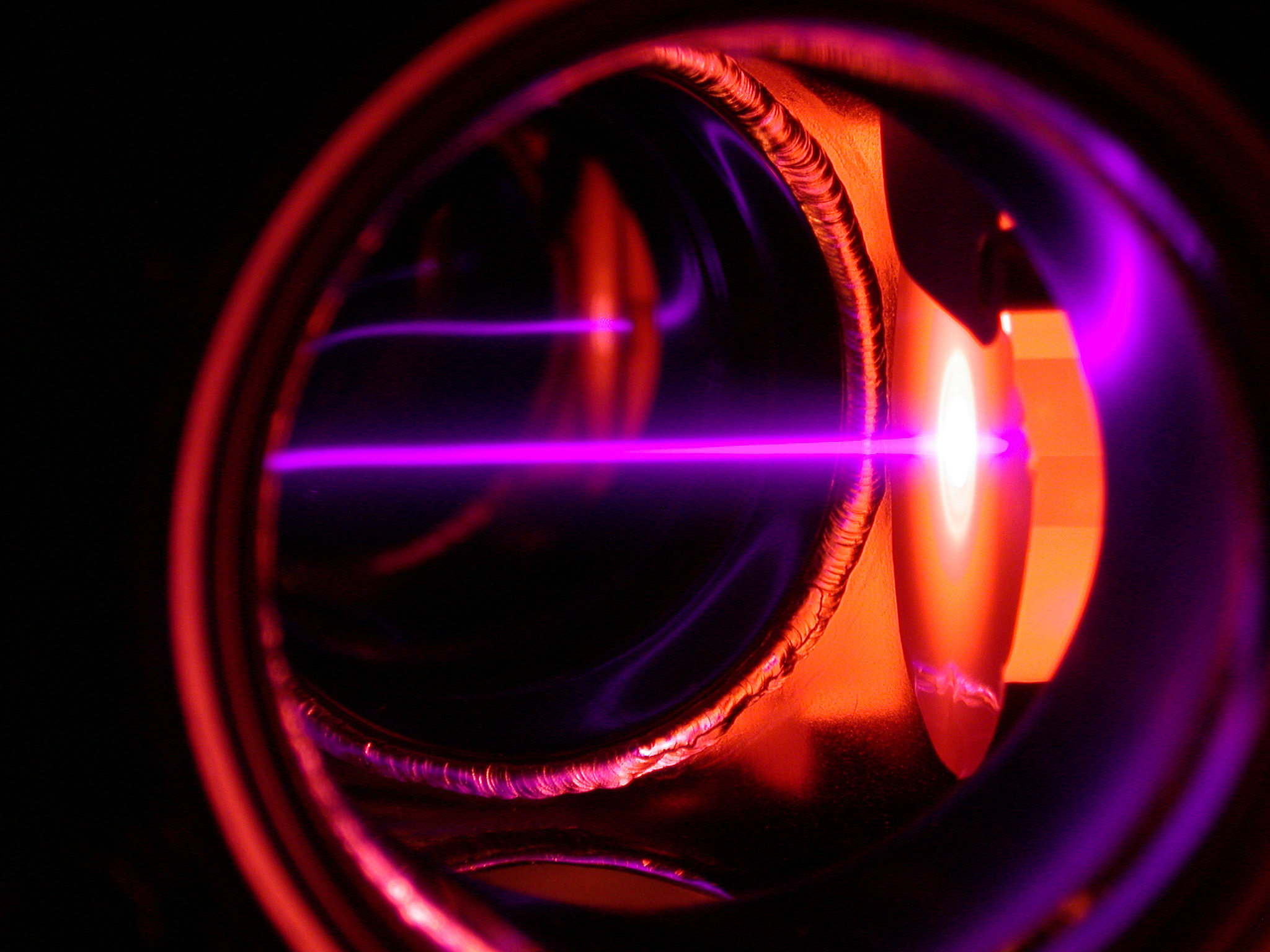
When a directed laser beam intersects a counter-propagating atomic beam in high vacuum, resonant photon absorption exerts a radiation pressure force directly opposing atomic motion. Each absorption event transfers a minute quantity of linear momentum from the photon field to the target atom. By tuning laser frequencies slightly below atomic resonance, the Doppler shift transforms this optical pressure into a velocity-dependent deceleration mechanism capable of reducing thermal velocities from hundreds of meters per second to centimeters per second.
In atomic physics, decelerating an atomic beam modifies its mean longitudinal velocity, whereas cooling a gas narrows the dispersion of random thermal velocities around that mean. A thermal cloud can drift with high directional velocity while maintaining narrow velocity variance, or exhibit zero center-of-mass momentum while sustaining high internal kinetic temperature. Temperature is defined thermodynamically by this random velocity spread:
Converting optical momentum kicks into thermodynamic cooling requires balancing directional momentum absorption, spontaneous photon scattering, and momentum diffusion across quantum internal states.
Photon momentum and the radiation pressure force
Although photons possess zero rest mass, each quantum of light carries discrete linear momentum determined by the de Broglie relation:
where is the reduced Planck constant, is the wave vector magnitude, and is the transition wavelength. When an isolated atom of mass absorbs a resonant photon propagating along unit vector , conservation of linear momentum requires the atom to receive an instantaneous velocity change:
For the sodium D2 line () or rubidium-87 D2 line (), a single photon kick alters the atomic velocity by merely or , respectively. Decelerating an atom from thermal oven speeds () to rest therefore demands roughly to consecutive absorption-emission cycles within an interaction length of tens of centimeters.
Following absorption, the atom enters an excited electronic state with finite natural lifetime , where is the spontaneous decay rate (natural linewidth). De-excitation occurs predominantly via spontaneous emission. Unlike absorption, which is unidirectional along the laser propagation axis , spontaneous emission occurs isotropically in random directions according to an atomic dipole pattern. When integrated over thousands of cycles, the momentum kicks from spontaneous emission average to zero:
The cumulative net force originates entirely from directed absorption, producing a steady radiation pressure force governed by the scattering rate :
Here, is the on-resonance saturation parameter relating laser intensity to the saturation intensity , and is the effective detuning of the laser frequency from the resting atomic resonance , adjusted for the velocity-dependent Doppler shift .
Optical molasses and Doppler cooling
To transform radiation pressure into a velocity-damping mechanism, Hänsch and Schawlow (1975) proposed illuminating atoms with counter-propagating laser beams tuned slightly below atomic resonance (), a configuration termed red detuning.
Consider an atom moving with velocity along a one-dimensional axis irradiated by two opposing, equal-intensity red-detuned beams. In the atom's reference frame, the beam propagating against the atomic velocity is Doppler-shifted toward resonance:
Conversely, the co-propagating beam is Doppler-shifted further away from resonance:
Because scattering rate increases as the effective detuning approaches zero, the moving atom preferentially absorbs photons from the opposing beam, experiencing a net retarding force that opposes its velocity. For small velocities such that , expanding the scattering force as a first-order Taylor series yields a linear viscous damping force:
where the damping coefficient is given by:
When the laser is red-detuned (), the coefficient is strictly positive, and the optical field behaves as a viscous fluid. Chu et al. (1985) demonstrated this effect in three dimensions using three orthogonal pairs of counter-propagating laser beams, coining the term optical molasses.
Optical molasses slows atoms rapidly, but it does not cool them to absolute zero. Every spontaneous emission event imparts an uncontrolled recoil momentum kick in a random direction. This stochastic recoil acts as a momentum diffusion process with diffusion coefficient . The rate of heating from momentum fluctuations eventually balances the rate of viscous cooling:
Equating the cooling power to the diffusion heating rate yields the theoretical minimum temperature achievable in a two-level Doppler model, known as the Doppler cooling limit:
This fundamental limit occurs at an optimal detuning of . For sodium atoms (), the Doppler limit is ; for rubidium-87 (), .
Zeeman slowing of atomic beams
While optical molasses efficiently damps atoms with velocities below a few meters per second, it cannot directly slow a thermal atomic beam emerging from an oven at hundreds of meters per second. As an atom decelerates from to rest, its Doppler shift changes by approximately , which is more than one hundred times the natural linewidth . Without dynamic compensation, a fixed-frequency laser immediately falls out of resonance, terminating the deceleration.
Phillips and Metcalf (1982) solved this challenge by inventing the Zeeman slower. A tapered solenoid surrounding the atomic beam produces an axially varying magnetic field along the beam propagation axis . In the presence of the magnetic field, the Zeeman effect shifts the magnetic sublevels of the ground and excited states by:
where and are the Landé -factors, and are magnetic quantum numbers, and is the Bohr magneton. By tailoring the magnetic field profile to satisfy:
the atomic transition frequency precisely tracks the changing Doppler shift as the atoms decelerate along . Constant deceleration yields a characteristic parabolic magnetic field profile , decelerating a substantial fraction of the thermal beam into the capture range of optical molasses.
Spatial confinement in the magneto-optical trap
Optical molasses provides velocity damping (), but it produces no spatial restoring force (). Atoms diffuse freely through the molasses and escape the beam intersection volume over hundreds of milliseconds. To achieve true spatial trapping, Raab et al. (1987) introduced the Magneto-Optical Trap (MOT), combining velocity-dependent Doppler cooling with position-dependent Zeeman restoring forces.
A MOT employs a magnetic quadrupole field generated by a pair of anti-Helmholtz coils carrying equal, opposing currents. Near the center of the trap, the magnetic field vanishes () and increases linearly in all directions:
where is the axial magnetic field gradient. Circularly polarized laser beams with opposing helicities ( and ) propagate along each axis. For an idealized atomic transition, the Zeeman effect splits the excited state into three magnetic sublevels with energy shifts .
When an atom is displaced to the right (), the local magnetic field shifts the state to lower energy, moving it closer to resonance with the red-detuned laser beam propagating to the left. By selecting polarization for the leftward-propagating beam, the atom selectively absorbs photons that kick it back toward the origin. Conversely, displacement to the left () shifts the state closer to resonance with the -polarized rightward beam. Near the trap center and for small velocities, the combined magneto-optical force takes the form of a damped harmonic oscillator:
where is the spatial spring constant. This dual damping and restoring force compresses neutral atomic vapors into dense, localized clouds containing millions of cold atoms.
In alkali atoms such as sodium, rubidium, or cesium, optical cycling transitions are not perfect two-level systems. Spontaneous decay from the excited cooling state occasionally branches into a lower hyperfine ground state outside the cooling cycle (for example, decay to from the state in ). Once in this dark ground state, the atom ceases to absorb the cooling light. To prevent trap loss, experimentalists apply an auxiliary repumping laser tuned to the transition, optically pumping dark atoms back into the primary cooling cycle ().
Polarization gradients and sub-Doppler cooling
In 1988, Lett et al. measured the kinetic temperature of sodium atoms in 3D optical molasses using ballistic expansion techniques, observing temperatures of . This measured temperature was substantially colder than the theoretical Doppler limit of , revealing that the simplified two-level Doppler theory failed to capture the full quantum dynamics of multi-level atoms.
Dalibard and Cohen-Tannoudji (1989) resolved this puzzle by formulating the theory of sub-Doppler polarization-gradient cooling, also known as Sisyphus cooling. In an optical molasses formed by counter-propagating beams with orthogonal linear polarizations (), spatial interference generates a standing wave in which the polarization state alternates every between linear, , linear, and circular polarizations.
Because atomic ground states possess multiple Zeeman sublevels (), non-uniform optical fields produce differential AC Stark shifts (light shifts):
where is the Rabi frequency and is the Clebsch-Gordan transition coefficient. In regions of polarization, sublevels with positive experience the deepest potential wells, whereas in regions of polarization, negative sublevels are shifted lowest.
As an atom moves through this spatially modulated standing wave, it climbs a potential hill, converting kinetic energy into potential energy. Near the crest of the hill, optical transition probabilities dictate that the atom is optically pumped into the complementary ground sublevel that sits at a potential valley. By repeatedly climbing potential hills and being repumped to valleys, the atom continuously loses kinetic energy on each optical cycle, mimicking the mythological ordeal of Sisyphus.
Polarization-gradient cooling ceases only when the atomic kinetic energy approaches the single-photon recoil limit, defined by the kinetic energy imparted by a single photon recoil:
For sodium, ; for rubidium-87, . Multi-level atoms can thus be cooled several orders of magnitude below the Doppler limit, approaching the microkelvin and nanokelvin regimes.
Measuring temperature from ballistic expansion
Because cold atomic samples reside within ultra-high vacuum chambers, direct thermodynamic thermometry is impossible. Instead, experimentalists determine temperature through time-of-flight (TOF) ballistic expansion.
Following cooling and trapping in optical molasses, all laser beams and magnetic fields are abruptly extinguished at , allowing the cloud to expand freely under pure ballistic motion. For a thermal gas with an initial Gaussian density distribution of spatial variance and Maxwell-Boltzmann velocity variance , the spatial width evolves according to:
After variable expansion times (typically 5 to 50 milliseconds), a resonant absorption imaging pulse illuminates the falling cloud onto a calibrated CCD camera. By recording absorption shadow profiles across multiple independent drop times, experimentalists plot as a linear function of . The vertical intercept provides the initial cloud radius squared, while the slope yields , determining the absolute kinetic temperature without ambiguity from the starting cloud size.
Applications across modern quantum science
Laser cooling and trapping techniques, recognized with the 1997 Nobel Prize in Physics to Steven Chu, Claude Cohen-Tannoudji, and William D. Phillips, provide the experimental bedrock for modern atomic, molecular, and optical (AMO) physics.
In optical atomic clocks, cooling neutral strontium or ytterbium atoms into optical lattice traps suppresses Doppler shifts and transit-time broadening, enabling fractional frequency uncertainties below , equivalent to losing less than one second over the age of the universe. In degenerate quantum gases, laser cooling serves as the indispensable pre-cooling stage for evaporative cooling to Bose-Einstein condensation (BEC) and degenerate Fermi gases. In quantum computing, magneto-optical traps supply cold neutral atoms that are loaded into reconfigurable arrays of optical tweezers, where single atoms serve as individually addressable qubits controlled via Rydberg state excitation.
References
- Chu, S., Hollberg, L., Bjorkholm, J. E., Cable, A., & Ashkin, A. (1985). Three-dimensional viscous confinement and cooling of atoms by resonance radiation pressure. Physical Review Letters, 55(1), 48-51. https://doi.org/10.1103/PhysRevLett.55.48
- Dalibard, J., & Cohen-Tannoudji, C. (1989). Laser cooling below the Doppler limit by polarization gradients: simple theoretical models. Journal of the Optical Society of America B, 6(11), 2023-2045. https://doi.org/10.1364/JOSAB.6.002023
- Hänsch, T. W., & Schawlow, A. L. (1975). Cooling of gases by laser radiation. Optics Communications, 13(1), 68-69. https://doi.org/10.1016/0030-4018(75)90159-5
- Lett, P. D., Watts, R. N., Westbrook, C. I., Phillips, W. D., Gould, P. L., & Metcalf, H. J. (1988). Observation of atoms laser cooled below the Doppler limit. Physical Review Letters, 61(2), 169-172. https://doi.org/10.1103/PhysRevLett.61.169
- Phillips, W. D. (1998). Nobel Lecture: Laser cooling and trapping of neutral atoms. Reviews of Modern Physics, 70(3), 721-741. https://doi.org/10.1103/RevModPhys.70.721
- Phillips, W. D., & Metcalf, H. (1982). Laser deceleration of an atomic beam. Physical Review Letters, 48(9), 596-599. https://doi.org/10.1103/PhysRevLett.48.596
- Raab, E. L., Prentiss, M., Cable, A., Chu, S., & Pritchard, D. E. (1987). Trapping of neutral sodium atoms with radiation pressure. Physical Review Letters, 59(23), 2631-2634. https://doi.org/10.1103/PhysRevLett.59.2631