
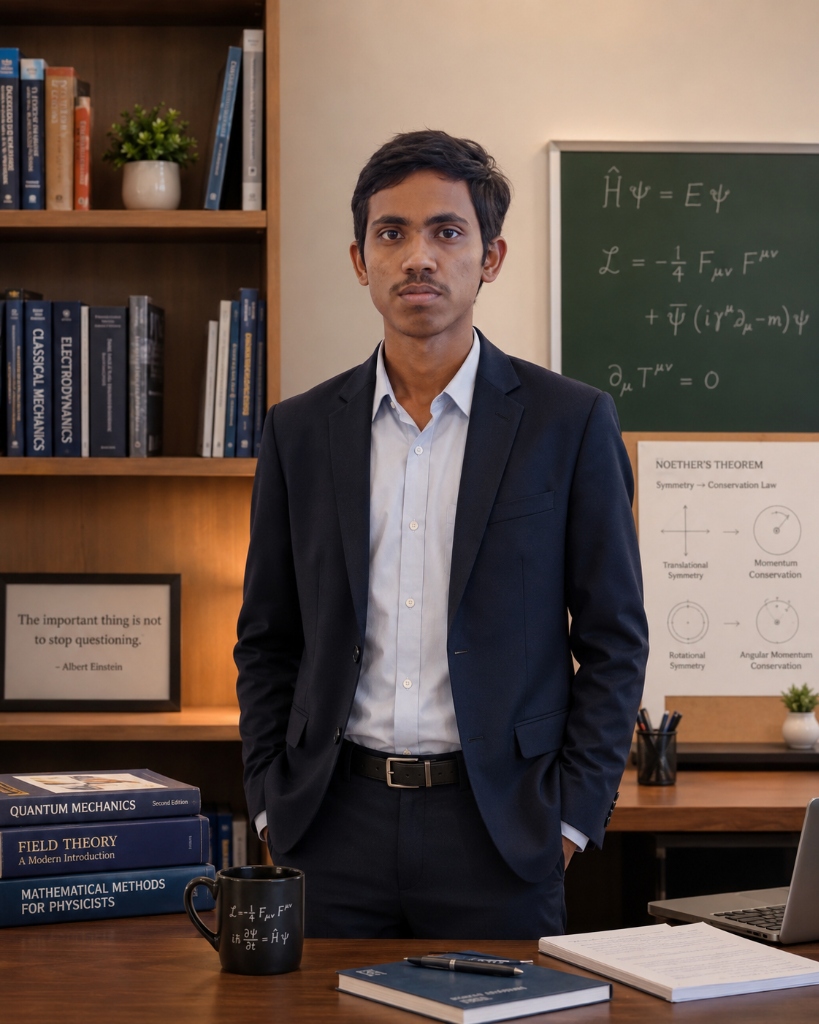
Santanu Pradhan
PhD Researcher in Physics
Department of Physics • Indian Institute of Technology Kanpur
"From black-hole perturbations to atomic coherence, I study how physical systems respond to disturbances—and how those responses can be calculated and measured."
My current experimental work in buffer-gas physics examines atomic coherence and diffusion in thermal vapor cells. My earlier research explored black-hole perturbations, quasinormal modes, and tidal Love numbers in modified gravity. Optical magnetometry, cold atoms, graphene optomechanics, and quantum information are future research directions.
Research Directions & Institutional Affiliations
Quantum Measurement & Buffer Gas Physics
Buffer Gas Physics (Current Project)
Experimental vapor cell dynamics & coherence preservation
Investigating collisional decoherence suppression, atomic spatial diffusion, and spin-polarization lifetimes in thermal alkali vapor cells through experimental spectroscopy and numerical transport modeling.
Optical Magnetometry & Quantum Sensing
Upcoming doctoral research in precision atomic sensing
Developing atomic vapor magnetometers operating in the Spin-Exchange Relaxation-Free (SERF) regime and exploring quantum noise limits for field-deployable magnetic sensors under India's National Quantum Mission.
Laser-Cooled Cold Atoms & Optical Trapping
Upcoming doctoral direction in ultra-cold atomic ensembles
Investigating laser-cooled atoms in Magneto-Optical Traps (MOTs), structured optical tweezers, atom-light interactions, and spin-fluctuation spectroscopy in coherently driven cold atomic ensembles.
Graphene & 2D Quantum Optomechanics
Upcoming research in hybrid nano-mechanical resonators
Exploring mechanical and optomechanical properties of graphene/SiNx hybrid resonators as quantum-limited motion transducers, non-linear amplifiers, and platforms for non-equilibrium steady states.
Quantum Information Theory & Weak Measurements
Upcoming direction in precision quantum metrology
Applying weak measurement protocols (Aharonov-Albert-Vaidman weak values), quantum state estimation, and quantum tomography to explore fundamental measurement limits and amplification.
Gravitation, Black Holes & Compact Objects
Earlier doctoral and master's research foundations
Exploration of general relativity, Fermi normal coordinates, tidal forces in black-hole spacetimes, and surface-regularized tidal Love numbers of white dwarfs in Eddington-inspired Born-Infeld (EiBI) modified gravity.
Computational Physics & Numerical Methods
Cross-cutting methodological stack
Developing and utilizing numerical differential equation solvers, scientific programming (Python, MATLAB, C++), Mathematica symbolic calculus, and data analysis pipelines across atomic and gravitational physics.
Key Manuscripts & Theses
Surface Regularized Tidal Love Numbers of White Dwarfs in Eddington-Inspired Born-Infeld Gravity
Surface Regularized Tidal Love Numbers of White Dwarfs in Eddington-Inspired Born-Infeld Gravity
Santanu Pradhan, Tapobrata Sarkar
AdS/CFT Introduction & Properties of Anti-de Sitter Black Holes: Quasi Normal Mode Calculation in Various Black Hole Models
AdS/CFT Introduction & Properties of Anti-de Sitter Black Holes: Quasi Normal Mode Calculation in Various Black Hole Models
Santanu Pradhan, Manavendra Mahato
Current & Recent Inquiries
Buffer Gas Physics & Atomic Vapor Coherence
Current Doctoral Experimental Project — Quantum Measurement Lab — Role: PhD Researcher
Conducting an experimental project investigating buffer-gas dynamics in thermal alkali vapor cells. The work focuses on analyzing collisional decoherence suppression, spatial diffusion rates, and optical pumping optimization to prolong atomic spin-coherence lifetimes.
Surface Regularized Tidal Love Numbers of White Dwarfs in Eddington-Inspired Born-Infeld Gravity
Previous Doctoral Research Project — Manuscript in Preparation — Role: PhD Researcher
Investigated the tidal deformability and surface-regularized tidal Love numbers of white dwarf stars in Eddington-inspired Born-Infeld (EiBI) gravity, analyzing modified gravity constraints on compact objects.
Latest Breakthroughs Across Disciplines
Figuring out where cosmic neutrinos come from is tricky—radio telescopes could help find 'ghost particles' origin
Neutrinos are funny little particles that weigh almost nothing, making them one of the universe's most elusive building blocks. They can come from objects as mundane as bananas and as exotic as supernovas—the exploding death throes of massive stars. Most neutrinos stream through ...
Scientists develop new system to boost prime editing in dicot plants
A new gene-editing system could make it easier for researchers to introduce precise genetic changes into crops such as tomatoes, soybeans and rapeseed. Developed by researchers in China, SmartPE improves prime editing efficiency in several dicot plants, addressing a major limitat...
Spatial mapping reveals how human urogenital organs codevelop during organogenesis
A new study has mapped human urogenital development in its native spatial context, revealing how neighboring organs coordinate their development through cellular communication and molecular signaling during embryogenesis.